Led by a cross-party panel, the final report of the Institute of Public Policy Research’s Environment and Justice Commission was published in July. It insists on ‘six shifts’ to make the response to climate emergency an opportunity, done with and by people, fairly and taking a whole-society approach, treating climate not in isolation but with nature, with government taking leadership but giving responsibility locally. Summarising 4 citizens juries spread through the UK, and analyses of carbon emissions and much else, on transport the report says:
“Transport decarbonisation plans must aim to make it possible to live a good life, wherever you are, without needing to own a car. This will mean that alternatives to the private car, including both public transport and shared mobility schemes, reach a level of convenience and affordability that makes them the obvious choice for personal travel for far more people than they do today.” (p99)
Roads, Runways and Resistance is a very different read. Published this year, Steve Melia entertainingly runs the winding course of government road policy, the industrial road lobby, and resistance to road schemes from 1990 to the present. Scepticism in providing for forecasts of ever-increasing traffic is a streak that has run through all governments during that time, keeping road-building a hotly contested policy.
Despite John Prescott’s 1997 promise ‘I will have failed if in five years there are not many more people using public transport and far fewer journeys by car’, the road lobby has always been powerful enough to keep policy confined to slowing traffic growth rather than putting a lid on it. The book’s final chapters chart the climate actions of recent years.
West Yorkshire Combined Authority have finally released to us the ‘Benefits Realisation Strategy and Monitoring Plan’ prepared for their traffic scheme between Bradford and Shipley in 2019. Although all the scheme details have been hidden and made unreadable, the list of aims and intended monitoring sadly reveals a lack of ambition on making a shift to traffic patterns that health and climate improvements demand.
The document claims to “summarise the principal scheme objectives and related benefits, the proposed interventions, opportunities to maximise and lock-in the benefits, their measurement and ownership” (p3).
The main objectives declared for the scheme (Table 3) are as follows:
“Increased capacity to a level which can accommodate the predicted demand from the residential and employment growth around the corridor
Reduce congestion and improve journey time reliability
Improve safety… with a particular focus on pedestrians and cyclists
To support … a modal shift from private cars
To improve air quality and environmental impacts”
While welcoming the aims of safety and improved air quality, it is fair to ask how will the aims be achieved? Though every measure is blacked out, the ways of monitoring the impact of the scheme are listed.
An initial concern is that the aims are not reflected in the ways the expected benefits will be measured (Table 4):
‘Increased capacity’ has no quantitative target, simply ‘widened highway’.
‘Modal shift from private cars’ has no target at all. Measurements will be made to reveal if there has been a change in walking, cycling and public transport, but no measurement or target of a shift to these away from private cars. WYCA has an aim from its climate emergency policy to reduce car journeys by between 21% and 38%, but there is no whiff of that realism here.
Bradford Council officers, who develop and implement the scheme on behalf of WYCA, have said that the objectives themselves are being further developed (Ref 16 in their June 2021 response to the Shipley Labour Party’s review of the scheme). It can only be hoped that the concerns of residents and Councillors will be taken on board. It would be better if we could have a conversation rather than rely on hope. Just for confirmation, Bradford-Shipley Travel Alliance is not party political and has support from community and environmental organisations as well as from several local branches of different political parties.
The reason given by WYCA for hiding or ‘redacting’ the details is:
“Redactions have been made to information specific to the scheme itself that is still under development. The data / information is changing frequently as options are developed, assessed and refined and it is therefore not appropriate to share these at this time. Evidence summarising the Full Business Case will be provided through further consultations and other statutory processes such as Planning Approval. … We are committed to openness and transparency however we also need to ensure the integrity of the development process is protected.”
It seems clear that WYCA and Bradford Highways do not at present intend to collaborate with residents, schools and businesses affected by the scheme. Currently, it appears they intend to consult only on a finished scheme, “the Full Business Case”, not gaining residents’ inputs to the formulation of the scheme. It is our intention to intervene to change that process and influence the plans to make them better for health and climate.
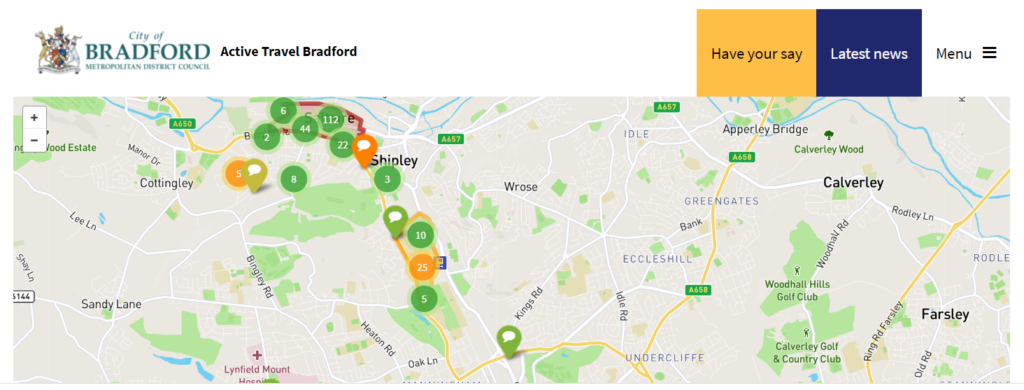
The consultation offers a map of the area and invites you to click on a place you think there is a problem. The problem might be speeding cars, rat-running through an area, parking, or anything that makes walking and cycling less attractive. You don’t have to suggest solutions, but you can if you think you know what would work: examples might be blocking a road at one end, speed bumps, one-way traffic, no-through-traffic signage, bus only stretches (bus gates), cycle or pedestrian only routes, lighting, information, training, maintenance, pedestrian seating or cycle parking, vehicle restrictions around schools, creation of walking or cycling groups, removal of steps or curbs, or whatever else you think would help. You can also read comments that have been made, and agree or disagree with them.
Bradford-Shipley Travel Alliance thinks that increased traffic capacity on Canal/Valley Road would put additional traffic pressure throughout Shipley, Frizinghall and many places from Keighley to Tong, Baildon to Wyke. Along with many of our affiliates we welcome measures to make cycling and walking easier, and to reduce the need for the car to be the dominant way of travelling.
Will Sanderson of Living Streets is encouraging residents to respond to this consultation, and educating residents about the impact of more traffic on the Bradford-Shipley route. Get in touch if you can join him knocking on doors on 7th and 8th August or any other time (admin@bsta.org.uk, or Will on 07970 654333).
Press release 15th July 2021, from Bradford-Shipley Travel Alliance
The government’s plan to make transport climate-friendly has been described by a Bradford transport campaign as “too little too slow”.
“The Transport Decarbonisation Plan will do nothing to reduce congestion nor provide health benefits as particulates emissions will not be reduced, indeed are likely to increase. It doesn’t address the need to reduce car traffic,” said Ludi Simpson from the Bradford-Shipley Travel Alliance.
Published on Wednesday, the government plan aims to cut in half the transport carbon emissions from all transport by 2035. It says that local authorities will have to make carbon reductions a fundamental part of local transport planning.
Ludi Simpson said “The targets won’t save us from the disastrous consequences of further man-made global warming. They are less than demanded by the Climate Change Commission which the government itself set up to advise it.’
The campaign says that local government should be given more support to implement solutions to the climate emergency. It calls for major changes to the traffic scheme that plans to increase motor traffic on Canal and Valley Roads between Bradford and Shipley. It calls for support at www.bsta.org.uk.
Who is this meeting aimed at? All BSTA supporters, who want to see a healthy and climate friendly outcome from the Bradford-Shipley road scheme. Chris Todd from Transport Action Network will facilitate this meeting, on Zoom. Please register here: https://zoom.us/meeting/register/tJUodeqsrD8vHdE3ccgI01L_WGsxUr6XMWb_
Where do we want to be at the end of it? (a) To understand better how we can influence the road scheme. (b) To propose actions that are taken away to work on. (c) To make the most of the period up to early 2022, the expected time for the final formal consultation on the road’s business case.
What will we cover in the workshop? (a)Who are the players (residents, councillors, business, media etc etc)? How to shift players with most interest to have more power/influence, and shift players with most power/influence to have more interest? (b) Create a timetable of decision points. What is a good rhythm of education and campaigning to best influence the scheme? (c) What are the key things that we need to win, drawn from Chris’s experience of other road campaigns.
Please help us prepare for the meeting in these two ways: